Kraft Paper Bags
 Kraft Standup Pouches
 Kraft Bowls
 Kraft Food Boxes
 SOS Paper bag
 Bottles & Jars
 Eco Products
 Accessories
You spent hours baking and decorating the perfect cake — the last thing you want is for it to arrive at the destination looking like it survived a car crash. Whether you’re a home baker, a small bakery owner, or just sending a birthday surprise to a loved one, knowing how to pack a cake for delivery is one of the most important skills you can have.
The good news? With the right cake packaging materials, a solid technique, and a little bit of know-how, you can deliver any cake — from a simple sponge to a towering fondant masterpiece — in perfect condition. This guide walks you through everything, step by step.
🎂 Why Proper Cake Packaging for Delivery Matters
Before we dive into the “how,” let’s talk about the “why.” A cake is fragile. It has soft frosting, delicate decorations, and a structure that can shift, crack, or collapse under pressure or movement.
Poor cake delivery packaging leads to:
- Smeared or cracked frosting
- Collapsed tiers on multi-layer cakes
- Decorations breaking off in transit
- Moisture damage from condensation
- A very unhappy customer (or recipient!)
Professional bakeries invest heavily in bakery packaging supplies because they know that presentation at the door is just as important as the taste inside. You should too.
🛒 What Materials Do You Need to Pack a Cake?
Getting the right supplies before you start is half the battle. Here’s a complete list of cake packaging materials you’ll need:
Essential Supplies
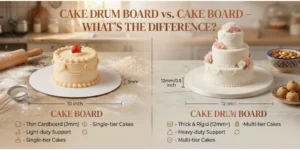
- Cake board — A sturdy base that supports the cake and prevents it from moving inside the box. Always use a board that matches or is slightly larger than your cake size. Browse cake boards in various sizes.
- Cake box for delivery — The right-sized, sturdy cardboard box is non-negotiable. Check out the full range of cake boxes available in multiple sizes.
- Cake drum board — For heavier or tiered cakes, a thick cake drum board provides extra rigidity and support.
- Non-slip mat — Placed under the cake board inside the box to prevent sliding.
- Bubble wrap — Wrap around the outside of the box for extra cushioning during transport. You can find bubble wrap rolls for this purpose.
- Packaging tape — Seal the box securely. Use a reliable packaging tape to keep everything closed.
- Cake dowel rods — Essential for tiered cakes to maintain the cake support structure.
- Cold packs — For cream cakes or cakes with perishable fillings, an insulated box with cold packs keeps the temperature stable.
Optional but Helpful
- Cake carrier box with a handle
- Shrink wrap for outer box protection — shrink wrapping rolls work great for this
- Paper bags designed for cake boxes — available in sizes like 13x13x13 inch or 15x15x15 inch for easy carrying
📦 How to Pack a Cake for Delivery: Step-by-Step
Let’s get into the actual process. Follow these steps carefully and your cake will arrive exactly as it left your kitchen.
Step 1: Choose the Right Cake Box
The best box to use for cake delivery is a sturdy, corrugated cardboard box that is the right size — not too big, not too small. Here’s the rule:
- The box should be the same size as your cake board or just 1 inch larger on each side.
- Too much empty space = the cake slides around.
- Too tight = the frosting gets squished against the walls.
For standard round or square cakes, choose from dedicated sizes:
- 6x6x5 inch cake box — perfect for small 6-inch cakes
- 8x8x5 inch cake box — ideal for medium cakes
- 10x10x7 inch cake box — great for standard celebration cakes
- 12x12x12 inch cake box — for larger cakes with tall frosting
- 18x18x10 inch cake box — for big party or wedding cakes
For tall cakes, use a tall cake box like the 10x10x12 inch tall cake box to avoid the lid touching the top decoration.
Step 2: Place the Cake on a Proper Cake Board
This is one of the most important steps that beginners skip — and regret later.
- Always place your cake on a cake board that is the same size as the cake base.
- The board acts as a rigid platform, making it easy to lift and preventing the bottom layer from cracking.
- For heavier cakes, use a cake drum board which is thicker and more supportive.
- Use a white and golden cake board for a premium presentation — these white and golden cake boards add a professional touch.
What to put under a cake to prevent movement: Place a small piece of non-slip mat or a dab of royal icing between the cake board and the box base. This acts as a natural cake stabilizer and stops any sliding.
Step 3: Chill the Cake Before Packing
This is a pro tip that most guides skip. Before you pack a cake for delivery:
- Refrigerate the frosted cake for at least 30–60 minutes.
- Cold frosting is firmer and far less likely to smear or dent during packing.
- This is especially critical when learning how to pack a cream cake for delivery — buttercream and whipped cream frosting are very sensitive to warmth.
- For fondant cakes, chilling also helps the fondant set and resist fingerprints.
Step 4: Secure the Cake Inside the Box
Now it’s time to place the cake (on its board) inside the box. Here’s how to secure a cake in a box properly:
- Place the non-slip mat on the bottom of the box first.
- Set the cake board on top of the mat.
- If there’s any gap between the board and the box walls, fill it with crumpled tissue paper or foam padding — never use newspaper as it can transfer ink.
- The cake should feel snug but not compressed.
- Close the box and gently shake it side to side — if you feel movement, add more padding.
Step 5: Seal and Label the Box
- Use strong packaging tape to seal all flaps securely.
- Write “THIS SIDE UP” and “FRAGILE — CAKE INSIDE” clearly on all sides.
- If using a paper bag for carrying, choose the right size — for example, an 11x11x11 inch paper bag fits a 10-inch cake box perfectly.
Step 6: Outer Packaging for Long-Distance or Courier Delivery
If you’re shipping a cake without damage via courier, you need an extra layer of protection:
- Place the sealed cake box inside a larger corrugated shipping box.
- Fill the gap between the two boxes with bubble wrap or foam padding on all sides — at least 2–3 inches of cushioning.
- For temperature-sensitive cakes, line the outer box with insulating material and add cold packs.
- Seal the outer box with packaging tape on all seams.
🎯 Special Cases: Different Cakes, Different Approaches
Not all cakes are created equal — and neither is their packaging. Here’s how to handle specific situations.
How to Pack a Multi-Tier Cake for Delivery
Tiered cakes are the most challenging to transport. Here’s what professionals do:
- Use cake dowel rods inside each tier to support the weight of the tier above. This is the backbone of any good cake support structure.
- Transport tiers separately whenever possible and assemble at the venue.
- If pre-assembled, use a very sturdy cake drum board as the base.
- Pack in a tall box with extra side padding.
- Drive slowly, avoid sharp turns, and keep the car cool.
How to Pack a Fondant Cake for Delivery
Fondant cakes are surprisingly resilient once set, but they still need care:
- Chill the cake before packing — fondant firms up beautifully in the fridge.
- Avoid bubble wrap touching the fondant directly — it can leave texture marks.
- Use a box with a transparent window so the recipient can see the design without opening the box. The 10x10x10 inch cake box with transparent window is perfect for this.
How to Pack a Cream Cake for Delivery
Cream cakes are the most delicate. Follow these rules:
- Always keep them cold — use an insulated cake box with a cold pack for cake delivery.
- Chill the cake for at least 1 hour before packing.
- Deliver as quickly as possible — avoid leaving in a hot car.
- Use a box with a window lid to minimize opening and disturbing the cream.
Best Way to Transport a Wedding Cake
Wedding cakes deserve extra attention:
- Transport tiers separately and assemble on-site.
- Use a flat, non-slip surface in your vehicle (a car mat works well).
- Keep the AC on — how to pack a cake in hot weather is all about temperature control.
- Have a repair kit: extra frosting, spatula, and decorations for touch-ups on arrival.
🚗 Tips for Delivering a Cake Long Distance
Tips for delivering a cake long distance go beyond just the box. The journey matters just as much as the packaging:
- Keep the car cool — never let the cake sit in a warm vehicle. Aim for 18–20°C inside the car.
- Drive smoothly — accelerate and brake gently. Sudden stops are the #1 cause of cake damage.
- Use a flat surface — place the box on the floor of the back seat or in the boot on a flat, non-slip mat.
- Avoid the boot on hot days — car boots heat up significantly and can melt frosting.
- Deliver as fresh as possible — the shorter the delivery window, the better.
- For courier shipping, always choose an overnight or express service to minimize transit time.
❓ How Do Bakeries Pack Cakes for Delivery?
Professional bakeries follow a very systematic process. Here’s what they do differently:
| Step | What Bakeries Do | Why It Works |
|---|---|---|
| Cake Board | Always use a board matching cake size | Provides rigid base support |
| Chilling | Refrigerate before packing | Firms up frosting |
| Box Size | Exact fit — no excess space | Prevents sliding |
| Non-slip base | Mat or royal icing dot in box | Stops movement |
| Dowels | Used in all tiered cakes | Structural integrity |
| Labeling | “Fragile” + “This Side Up” | Careful handling by couriers |
| Temperature | Insulated boxes + cold packs | Keeps cream/butter stable |
The key takeaway: bakeries treat every cake delivery as a precision operation. You should too.
🌡️ How to Pack a Cake in Hot Weather
Pakistan’s summers are brutal, and heat is the enemy of frosted cakes. Here’s how to handle it:
- Chill the cake longer — 2 hours minimum before packing in summer.
- Use an insulated cake box or wrap the regular box in a thermal bag.
- Add cold packs around the box (not directly on the cake).
- Schedule deliveries for early morning or evening to avoid peak heat.
- Never leave a cake in a parked car in summer — even 10 minutes can cause the frosting to melt.
- For fondant cakes, a light dusting of cornstarch before packing helps prevent sticking in humidity.
🧁 Packing Cupcakes for Delivery
Cupcakes have their own packaging needs. The key is preventing them from tipping over and keeping the frosting intact.
- Use dedicated cupcake boxes with individual cavities — like 3-cupcake boxes, 9-cupcake boxes, or a long cupcake box with 12 cavities.
- For premium presentation, use boxes with clear lids — the 4-cupcake clear lid box or 12-cupcake clear lid lets customers see the product without opening.
- Single cupcakes can be packed in single cupcake boxes or single transparent cupcake boxes.
- Keep cupcake boxes level at all times during transport.
🍫 Packing Brownies for Delivery
Brownies are denser and more forgiving than cakes, but they still need proper packaging:
- Use dedicated brownie boxes in the right cavity count — from 2-brownie boxes to 12-brownie boxes.
- Individual brownie boxes prevent them from sticking together.
- For gifting, a 4-brownie white box looks clean and professional.
💡 Common Mistakes to Avoid
Here are the most frequent errors people make when packing cakes for delivery — and how to avoid them:
- ❌ Using a box that’s too large — the cake slides and the frosting hits the walls. Always size the box to the cake.
- ❌ Skipping the cake board — without a board, the bottom of the cake can crack or stick to the box.
- ❌ Packing a warm cake — always chill first. Warm frosting smears instantly.
- ❌ Not sealing the box — an unsealed box can pop open. Use tape on all flaps.
- ❌ Placing the box on a car seat — seats are angled and cause the cake to tilt. Use the floor or a flat boot surface.
- ❌ Forgetting to label — “Fragile” and “This Side Up” labels make a real difference, especially with couriers.
🛍️ Where to Get Quality Cake Packaging Supplies in Pakistan
Finding the right bakery delivery supplies in Pakistan used to be a challenge — but not anymore. CustomBox.pk offers a comprehensive range of bakery packaging supplies including:
- All sizes of cake boxes with and without transparent windows
- Cake boards and cake drum boards in every size
- Cupcake boxes with clear lids
- Brownie boxes in multiple cavity options
- Bubble wrap and packaging tape for outer protection
- Paper bags for cake boxes for easy customer carrying
- Complete bakery packaging solutions for home bakers and professional bakeries
Everything you need is in one place — no need to hunt across multiple suppliers.
✅ Conclusion: Deliver Every Cake With Confidence
Packing a cake for delivery doesn’t have to be stressful. With the right cake box for delivery, a proper cake board, a few minutes of chilling time, and the techniques covered in this guide, you can protect your cake during delivery — whether it’s traveling across the street or across the city.
The formula is simple: right box size + sturdy board + secure padding + cold temperature + smooth driving = a perfect cake arrival every single time.
Your cake deserves to arrive looking as beautiful as it did when it left your kitchen. And now you have everything you need to make that happen.
🛒 Ready to upgrade your cake packaging? Browse the complete range of bakery packaging supplies at CustomBox.pk — from cake boxes and boards to cupcake containers and brownie boxes. Order today and deliver with confidence!