Kraft Paper Bags
 Kraft Standup Pouches
 Kraft Bowls
 Kraft Food Boxes
 SOS Paper bag
 Bottles & Jars
 Eco Products
 Accessories
The Future of Packaging in Pakistan will be shaped by much more than attractive boxes and colourful printing. Packaging is increasingly expected to protect products, reduce waste, communicate brand values, improve delivery efficiency, and connect physical products with digital experiences. From sustainable paper-based boxes to QR-enabled labels and right-sized e-commerce packaging, Pakistani businesses are entering a new phase in which packaging becomes an essential part of the product—not merely something wrapped around it.
This transformation will influence almost every major commercial sector in the country. Food businesses need safer and more practical delivery packs. Online sellers require durable but lightweight shipping boxes. Pharmaceutical manufacturers need tamper evidence and improved traceability. Exporters must respond to international expectations concerning packaging materials, labelling, product safety, and environmental responsibility.
For Pakistani businesses, the direction is clear. Packaging decisions can influence customer trust, delivery costs, product damage, repeat sales, and brand reputation. The latest packaging trends in Pakistan already indicate that sustainability, e-commerce, convenience, and memorable customer experiences are becoming central to packaging strategy.
📦 The Changing Role of Pakistan’s Packaging Industry
The Pakistan Packaging Industry supports a broad economy covering food and beverages, pharmaceuticals, cosmetics, textiles, electronics, agriculture, retail, exports, and online commerce. Every sector has different requirements, yet most businesses share three priorities: protecting the product, controlling costs, and presenting the brand professionally.
In the past, packaging decisions were often based mainly on the initial price of a box, pouch, or container. That approach is gradually changing. More businesses are beginning to consider the total cost of packaging. This includes the cost of product damage, customer complaints, storage requirements, packing time, courier charges, replacements, returns, and lost trust.
Consider a small skincare brand shipping glass bottles nationwide. An inexpensive box may appear to reduce costs. However, if the bottles move freely inside it and arrive damaged, the brand must replace the products, pay for another delivery, and manage an unhappy customer. A properly sized corrugated box with a suitable insert may cost slightly more per unit but reduce the total expense.
The same principle applies to restaurants, bakeries, online stores, and exporters. Packaging must be designed around the complete product journey—from filling and storage to transportation, customer use, and disposal.
This is why the future of the Pakistan Packaging Market will be increasingly solution-oriented. Businesses will expect packaging suppliers to offer practical advice about materials, structure, printing, barriers, food safety, product protection, and efficient dimensions. Instead of purchasing a generic box, companies will search for custom packaging solutions in Pakistan that solve specific business problems.
🌱 Sustainability Will Become a Business Requirement
Sustainable Packaging in Pakistan is moving from a niche preference toward a wider commercial expectation. Consumers are more aware of plastic waste, blocked drainage systems, overflowing landfill sites, and unnecessary layers of disposable material. At the same time, businesses want packaging that communicates responsibility without increasing costs beyond a practical level.
Sustainable packaging, however, is not simply about replacing every material with brown paper. A genuinely responsible packaging system considers material sourcing, manufacturing, transportation, product protection, recyclability, reuse, and disposal.
A paper package that fails to protect food from moisture may create more waste than a carefully designed barrier pack. Similarly, a package labelled biodegradable may provide limited environmental benefit if customers do not receive disposal instructions or appropriate composting facilities are unavailable.
The most practical starting point for Pakistani businesses is reduction. Brands can remove unnecessary layers, avoid oversized boxes, reduce empty space, and choose the lightest material that still protects the product. Once the packaging has been simplified, recyclable, reusable, renewable, or biodegradable materials can be evaluated for the intended application.
♻️ Materials likely to gain wider adoption
Businesses will increasingly compare materials according to performance rather than marketing language. Important options include:
- Recyclable corrugated board and paper-based packaging
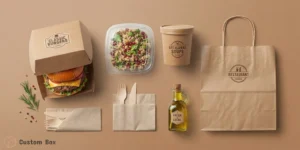
- Kraft paper bags, food boxes, bowls, and stand-up pouches
- Reusable rigid packaging for selected products
- Compostable materials for suitable controlled applications
- Lightweight structures that reduce material and transport demand
- Plastic packaging alternatives such as paper and responsibly sourced wood
For example, a clothing retailer can replace an oversized shipping carton filled with plastic cushioning with a right-sized paper mailer or compact corrugated box. A takeaway restaurant can use kraft food boxes or bowls where the structure and lining are suitable for the meal. A café can pair paper cups with wooden stirrers rather than automatically using plastic accessories.
Businesses exploring Eco-Friendly Packaging in Pakistan can review this detailed guide to eco-friendly packaging options and browse the available eco-friendly product range. Brands deciding between common carrier materials can also consult the kraft paper bag versus plastic bag comparison.
The strongest environmental claims will be specific and verifiable. Instead of simply printing “eco-friendly” beside a green leaf, a brand can explain that a box uses recyclable paper, contains less material than its previous design, or can be reused for returns. Clear disposal instructions make sustainability more useful and reduce the risk of greenwashing.
🛒 E-Commerce Packaging Will Become Smaller and Stronger
The rapid development of online retail has changed what packaging must accomplish. A retail package designed for a shelf may not survive courier sorting, stacking, motorcycle delivery, changing weather, or repeated handling across Pakistan’s logistics network.
As a result, E-commerce Packaging in Pakistan will increasingly be designed around the delivery journey. The best shipping box is not necessarily the thickest or largest option. It is the one with the correct dimensions, board strength, closure method, internal support, and resistance for the product being shipped.
Imagine an Instagram jewellery seller placing a bracelet box inside a large shipping carton. The oversized carton consumes more material, requires additional filler, takes up more courier space, and allows the item to move during delivery. A compact e-commerce mailer with a fitted paper insert could provide better protection while creating a more polished unboxing experience.
Right-sizing will therefore become an important part of supply chain efficiency. When boxes closely match product dimensions, businesses can reduce material use, storage requirements, and empty space. Lightweight packaging may also help control shipping costs without compromising protection.
Future-ready e-commerce packaging will concentrate on four outcomes: damage prevention, tamper awareness, efficient dimensions, and convenient returns. Tear strips, resealable closures, printed handling instructions, protective inserts, and simple return guidance can all improve the customer experience.
Online businesses can explore dedicated e-commerce packaging boxes for different product dimensions. Sellers can also use the complete guide to e-commerce packaging in Pakistan to understand material selection, branding, and courier-related requirements.
Packaging will also function as a physical marketing channel. A social media advertisement may disappear in seconds, but a branded delivery box enters the customer’s home. It can introduce other products, communicate care instructions, display social media details, or encourage customers to share an unboxing video.
📲 Smart Packaging Will Connect Products with Customers
Smart Packaging in Pakistan is likely to grow as smartphones become more deeply integrated into shopping, payments, customer service, and product verification. Smart packaging does not always require expensive electronics. In many cases, a well-placed QR code can create a useful digital connection at a low cost.
A food brand could use a QR code to display ingredients, preparation instructions, allergen information, or product origin. A cosmetics company could connect customers to an application tutorial. An online seller could use the code for returns, warranty registration, or customer support. A pharmaceutical product could offer verification details or guidance on correct storage and use, subject to applicable regulations.
More advanced systems may use RFID technology, Internet of Things sensors, or blockchain-based traceability. These technologies could help monitor high-value goods, temperature-sensitive products, industrial supplies, and export shipments. However, their adoption will depend on cost, infrastructure, data management, and the value of the product being protected.
For most small and medium-sized Pakistani businesses, the sensible starting point is simple. A QR code should solve a real customer problem rather than exist as decoration. It must lead to a mobile-friendly page, load quickly, and provide information that is not already obvious on the package.
Brands considering connected packaging can learn more through the guide on what smart packaging is and how it works. The practical value of smart packaging will come from convenience, transparency, traceability, and stronger customer relationships—not technology for technology’s sake.
🎨 Digital Printing Will Make Custom Packaging More Accessible
Traditional printing methods are highly effective for large production quantities, but small businesses often require shorter runs and greater flexibility. Digital Printing for Packaging can help meet this need by making personalised and small-batch production more practical.
A bakery may want different box designs for weddings, birthdays, corporate events, and seasonal collections. A cosmetics start-up may need a limited launch quantity before committing to a larger order. A coffee roaster may want separate labels for different origins or blends. Digital printing technology can support these variations without requiring the same setup process as some conventional methods.
This flexibility may also help brands test packaging design innovation before making a major investment. Businesses can compare two layouts, change product information, update QR codes, or create regional versions based on customer preferences.
At the same time, custom printing should remain functional. Beautiful graphics cannot compensate for weak structure, unreadable text, poor colour contrast, or missing product information. A successful design balances visual identity with practical communication.
For companies developing their branding, custom printed boxes in Pakistan can help create a more consistent customer experience. Businesses can also review how packaging works as a marketing tool before finalising colours, typography, brand messages, and unboxing elements.
Minimalist packaging is also likely to become more visible. Clean layouts, simple colour palettes, clear labels, and uncluttered information can help products look more trustworthy and premium. In many cases, removing visual noise is more powerful than adding another slogan, badge, or decorative element.
🍱 Food Packaging Will Prioritise Safety and Delivery Performance
The Food Packaging Industry in Pakistan faces a demanding combination of safety, freshness, affordability, presentation, and delivery performance. Packaging for dry foods, hot meals, frozen items, bakery products, beverages, and sauces cannot be treated as one category.
A biryani delivery container must manage heat, oil, steam, and movement. A cake box needs structural stability and adequate clearance around decoration. A pouch for coffee must help preserve aroma and protect the product from oxygen and moisture. A pizza box needs ventilation, stacking strength, and food-appropriate material.
This is why food businesses must evaluate packaging according to the product rather than selecting it only by appearance. Food contact suitability, secure closure, barrier performance, storage conditions, portion size, and expected delivery time should all be considered.
As food delivery and cloud kitchens grow, packaging will also need to reduce leakage and maintain product quality during motorcycle transport. Tamper-evident seals and clear labelling can strengthen customer confidence. Meanwhile, restaurant branding on bags, boxes, cups, and labels can create a consistent experience across takeaway and delivery orders.
A restaurant reviewing its options can explore food packaging solutions and use the guide on choosing food packaging for a new restaurant. Bakeries can also view dedicated bakery packaging products designed for cakes, cupcakes, brownies, and other delicate items.
The table below summarises how different industries may respond to emerging packaging expectations.
| Industry | Main Packaging Need | Likely Direction | Practical Example |
|---|---|---|---|
| E-commerce | Transit protection | Right-sized corrugated boxes | Compact mailer with paper insert |
| Food delivery | Safety and temperature control | Secure, leak-resistant packs | Kraft bowl with a fitted lid |
| Pharmaceuticals | Trust and traceability | Tamper evidence and smart labels | QR-enabled verification label |
| Retail and cosmetics | Brand differentiation | Custom printing and premium design | Printed box with fitted insert |
| Agriculture exports | Shelf life and compliance | Strong barriers and clear labels | Moisture-resistant export pack |
Across these sectors, the winning solution will balance product protection, customer convenience, cost, sustainability, and regulatory suitability. No single material or design will work equally well for every application.
🧴 Flexible Packaging Will Continue to Evolve
The Flexible Packaging Market in Pakistan is important because pouches and films are lightweight, space-efficient, and suitable for many food, household, cosmetic, and agricultural products. Stand-up pouches are particularly popular for coffee, dry fruits, spices, snacks, powders, pickles, and liquid products.
The Future of Flexible Packaging will be shaped by better barriers, improved closures, material reduction, and increased interest in recyclable structures. Zippers, valves, spouts, windows, and flat-bottom formats can add convenience while helping products stand upright and remain protected after opening.
For example, a dry fruit business may choose a kraft stand-up pouch with a window to improve shelf presentation. A coffee seller may require a valve pouch to release gases while helping protect aroma. A pickle business may benefit from a secure spout or high-barrier pouch designed for the contents.
Businesses can review the range of kraft stand-up pouches and use the kraft pouch size guide to match package capacity with product quantity.
However, flexible packaging also presents recycling challenges, especially where multiple material layers are combined. Packaging companies in Pakistan will therefore face pressure to explore structures that preserve barrier performance while improving material recovery. This will require cooperation between manufacturers, brands, waste collectors, recyclers, and policymakers.
💊 Pharmaceutical Packaging Will Focus on Trust and Traceability
Pharmaceutical Packaging in Pakistan must protect products from moisture, light, contamination, tampering, and incorrect use. It must also communicate critical information clearly. Because medicine directly affects health, packaging errors can have serious consequences.
Future improvements may include stronger tamper-evident features, clearer typography, better batch identification, machine-readable codes, and digital verification. Intelligent packaging could help patients access dosage guidance, storage instructions, or authenticity information through a secure digital channel.
Active packaging may also become more relevant for products requiring specific environmental conditions. Indicators and sensors can potentially show whether temperature or moisture limits have been exceeded, although suitability will depend on product risk, technical feasibility, and cost.
Accessibility should remain central. Important instructions need readable contrast and sensible type sizes. Similar-looking products should be visually distinguishable. Packaging should be easy to handle while remaining child-resistant where required.
Pharmaceutical manufacturers must align innovations with relevant laws, quality systems, and standards. Smart features cannot replace validated materials, accurate information, secure sealing, or responsible manufacturing controls.
🤖 Automation Will Improve Speed and Consistency
Packaging Automation in Pakistan will gradually expand as manufacturers and high-volume brands seek faster production, consistent quality, and lower material waste. Automated filling, sealing, coding, labelling, inspection, and palletising systems can reduce repetitive manual work while improving accuracy.
Artificial intelligence may support quality control by identifying print defects, damaged seals, incorrect labels, or dimensional inconsistencies. Automation and robotics can also improve packing speed and help companies handle seasonal demand without sacrificing consistency.
This does not mean that every small business needs an expensive automated line. Automation can be introduced gradually. A growing food brand may begin with a reliable heat sealer and label applicator. An e-commerce warehouse may introduce barcode scanning and standardised packing stations. A large manufacturer may invest in integrated machinery connected to inventory and quality-control systems.
The goal is not simply to replace human work. It is to reduce errors, use materials efficiently, improve workplace safety, and allow employees to concentrate on quality, maintenance, design, and customer service.
⚖️ Regulation and Extended Producer Responsibility
Packaging regulations are likely to play a larger role in material selection, labelling, food safety, and plastic waste management. Businesses may need to follow requirements or guidance associated with relevant government bodies, environmental authorities, food authorities, and the Pakistan Standards and Quality Control Authority.
The wider discussion around single-use plastics, plastic bag restrictions, waste management, and Extended Producer Responsibility may also influence future packaging decisions. Under producer-responsibility approaches, businesses can be expected to consider what happens to packaging after customers have used the product.
For brands, regulatory readiness begins with better information. Companies should know what materials they use, which suppliers provide them, whether they are appropriate for the product, and what claims are printed on the pack. Accurate records also help when businesses sell through major retailers or export products.
Clear labelling is equally important. Food and consumer product businesses should ensure that required information is visible, accurate, and easy to read. Environmental claims must not mislead customers. Terms such as recyclable, biodegradable, compostable, and reusable have different meanings and should not be used interchangeably.
🚧 Challenges Facing the Pakistan Packaging Market
Although the direction is promising, the transition will not be effortless. Sustainable materials may cost more or have limited local availability. Recycling infrastructure varies significantly between locations. Many consumers still make purchasing decisions primarily according to price. Small businesses may also lack technical knowledge about structural design, printing, and food-safe materials.
Another challenge is the gap between appearance and performance. Some businesses choose a package because it looks premium in a photograph without testing how it behaves during storage or delivery. Others add excessive material because they assume more packaging always means better protection.
The practical answer is testing. Brands should conduct small trials before placing large orders. They can fill the package with the real product, store it under expected conditions, stack it, transport it, and evaluate how easily a customer can open and dispose of it.
Packaging suppliers must also communicate honestly. A good supplier should explain material limitations instead of promising that one format is perfect for every product. This expertise will become a valuable point of difference as the market matures.
🚀 How Pakistani Businesses Can Prepare for the Future
Preparing for emerging packaging trends does not require changing every package at once. A structured packaging audit can reveal where the greatest opportunities exist.
Businesses should first identify recurring problems such as leakage, crushing, broken products, high courier costs, excessive filler, slow packing, or confusing labels. Each issue can then be connected to a measurable packaging improvement.
A restaurant might discover that loose lids are causing delivery complaints. An online store may find that three box sizes could replace ten inconsistent options. A bakery may reduce damage by matching its cake boards and boxes more accurately. A coffee brand may improve freshness by moving to a valve pouch with a reliable zipper.
Brands should prioritise the following actions:
- Test packaging with real products under realistic delivery conditions.
- Remove unnecessary layers without weakening protection.
- Select dimensions that reduce empty space and material use.
- Add clear product, handling, and disposal information.
- Track damage rates, complaints, returns, and customer feedback.
- Work with suppliers who understand materials and applications.
Businesses can begin their evaluation by browsing the complete CustomBox.pk packaging shop. Those developing made-to-order solutions can also learn what a custom packaging box is and how structure, size, and printing can be adapted to a product.
🔮 What the Next Generation of Packaging Will Look Like
The next generation of packaging in Pakistan will not be defined by one material or technology. It will combine several improvements: lighter structures, better product protection, responsible materials, flexible printing, digital interaction, automation, and clearer consumer information.
Corrugated packaging will remain important for e-commerce and transportation. Kraft paper packaging will expand where it offers suitable performance. Flexible packaging will evolve toward improved convenience and more responsible material structures. Rigid packaging will continue where durability, display, or product protection justifies it.
The most successful brands will avoid treating sustainability, cost, and customer experience as separate goals. Right-sized packaging can use less material, reduce transport space, prevent damage, and create a cleaner presentation at the same time. Smart design often improves several outcomes together.
Consumer preferences will remain influential. People increasingly notice whether a package is easy to open, excessive, reusable, attractive, or clearly labelled. A memorable package does not need to be elaborate. It needs to feel appropriate for the product and considerate of the person receiving it.
🎯 Final Thoughts: Packaging Is Becoming Part of the Product
The Future of Packaging in Pakistan belongs to solutions that are practical, protective, responsible, and connected. Packaging will no longer be judged only by how it looks on a shelf. It will be evaluated by how well it survives delivery, preserves the product, controls cost, communicates information, supports the brand, and fits into a more sustainable supply chain.
For Pakistani manufacturers, retailers, food businesses, exporters, and online sellers, this shift creates a valuable opportunity. Businesses that test new materials, improve dimensions, introduce meaningful smart features, and communicate honestly can earn stronger customer trust.
The transition does not require chasing every trend. It requires understanding the product, its journey, and the customer. When packaging solves real problems, it becomes more than a container. It becomes a silent salesperson, a quality signal, and an important part of the brand experience.
📣 Build Packaging Ready for What Comes Next
Explore CustomBox.pk to find e-commerce boxes, kraft pouches, food packaging, bakery boxes, paper bags, protective materials, and other practical packaging solutions. Select packaging that protects your products, strengthens your presentation, and supports long-term business growth.
❓ Frequently Asked Questions
What is the future of packaging in Pakistan?
The future will focus on sustainable materials, right-sized boxes, smart labels, custom printing, stronger e-commerce packaging, automation, and improved product traceability. Businesses will expect packaging to protect products while reducing waste and improving customer experience.
Why is sustainable packaging becoming important in Pakistan?
Sustainable packaging can help reduce unnecessary material, plastic waste, transport demand, and environmental impact. It also responds to changing consumer preferences and gives brands an opportunity to demonstrate responsible business practices.
What is smart packaging?
Smart packaging uses technologies such as QR codes, RFID tags, sensors, or digital verification tools to provide information, improve traceability, confirm authenticity, or connect customers with support and product guidance.
Which packaging is best for e-commerce businesses?
The best e-commerce packaging depends on product dimensions, weight, fragility, delivery conditions, and branding requirements. Right-sized corrugated boxes, mailers, protective inserts, strong closures, and tamper-aware features are common options.
Are kraft boxes and pouches eco-friendly?
Kraft packaging can be a responsible option when it reduces unnecessary material, protects the product effectively, and enters an appropriate recycling or recovery system. Businesses should also consider linings, coatings, adhesives, and barriers when assessing the complete package.
How can packaging reduce delivery costs?
Right-sized and lightweight packaging can reduce empty space, filler use, storage demand, and chargeable shipping volume. Effective structural design can also prevent product damage, replacements, and customer returns.
How can small businesses improve their packaging?
Small businesses can begin by identifying damage and customer complaints, reducing unnecessary material, standardising sizes, improving labels, testing packages during real deliveries, and choosing suppliers who understand the product’s requirements.
What packaging is suitable for food delivery?
Food delivery packaging should be selected according to temperature, moisture, oil content, portion size, transportation time, and food safety needs. Secure lids, leak-resistant structures, ventilation, tamper evidence, and clear labels may be required depending on the meal.